Event Calendar
A Scientist’s Primer on Mental Health

Mental health is often misunderstood, especially in academia. Myths about what causes psychiatric conditions, who is affected, and how these challenges show up can create barriers to support and open conversation. Yet research shows that mental health struggles, from anxiety to depression, are far more common in academic and scientific communities than many realize.
Join us for this seminar and facilitated discussion, designed for researchers, by researchers. We’ll explore:
- the prevalence of mental health illness in general and academic populations
- signs and symptoms, highlighting those seen in academic settings
- the science underlying the causes and treatments of mental illnesses, with an emphasis on depression and anxiety (most common mental illness)
Together, we will identify gaps, barriers and opportunities for support at your institute. The discussion will be shaped by your questions and experiences, and we’ll measure knowledge before and after to ensure the conversation leaves you with actionable insights.
KSQM covers the cost for this event.
Hanna Sänger, Mental Health Counsellor & Coach
Dragonfly Mental Health
Dr. Yu Goldscheider
Institut für Theoretische Festkörperphysik/Garst
KSQM/KIT
Wolfgang-Gaede-Str. 1
76131 Karlsruhe
Tel: 072160846030
Fax: 072160847040
Mail: ksqm ∂does-not-exist.kit edu
https://www.ksqm.kit.edu/index.php
Scientific Staff
Please reigster here ASAP if you are KSQM member. If not, please write an email to yu goldscheider ∂does-not-exist.kit edu.
Online Registration




In this year's summer school, we will cover both fundamental concepts and practical applications of Graph Neural Networks. Participants can expect a mix of lectures and interactive sessions that provide insight into the mathematical foundations as well as real-world use cases of graph-based machine learning methods.
More info and registration
This year's group retreat will be from November 2-4, 2026 at the Black Forest. Save the date!
More info
Find an overview of past events in our timeline.
link
The workshop was co-organized by doctoral researchers from HGS MathComp (Heidelberg) and KCDS and provided a smooth introduction to a challenging, yet highly relevant topic: Stochastic partial differential equations in applied mathematics. It took place from March 9-11, 2026 in Heidelberg.
More info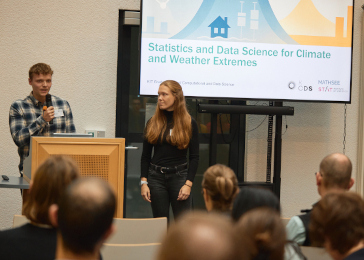
A worthwhile journey to KIT Institute of Statistics: Talks by Sebastian Engelke, Linda Mhalla, Gabriele Messori, Petra Friederichs gave insights into state-of-the-art research in statistics and data science for climate and weather extremes. The workshop took place on November 20, 2025 at the Campus South outpost in Blücherstraße.
Read more here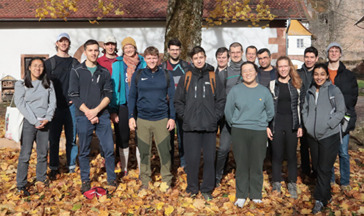
A friendly place in the Black Forest, sunny autumn weather, good food, lively (scientific) discussions, board games and activities ranging from powerpoint karaoke to trampoline jumping were the ingredients of a lovely KCDS Retreat this year! It took place from November 10-12, 2025.
Read more
Short courses and an interactive tutorial on Neural Operators and Gaussian Processes, along with a poster session and lots of opportunities for networking with other researchers - that was the KCDS Summer School 2025! It took place from August 27-29, 2025 at KIT Campus South.
Read more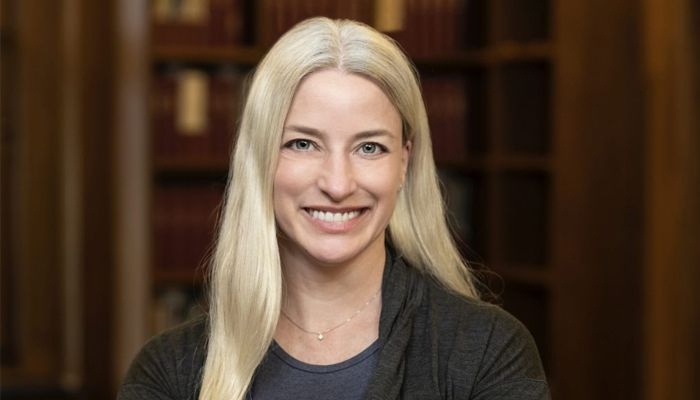
KIT International Excellence Fellow Prof. Victoria Stodden invited the KIT community, especially early career researchers, to create ideas and proposals for facilitating research that is data-, compute-, or AI-enabled - taking reproducibility to action! The workshop took place on January 21, 2025 at Triangel Studio.
Read more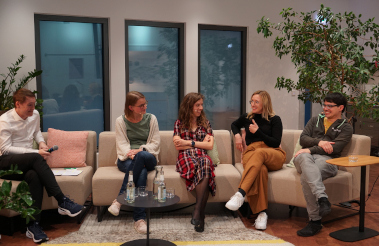
From Computational and Data Science to Industry and Academia - four KIT Alumni gave insights into their jobs during a lively panel discussion on October 11, 2024 at Triangel Space.
Read more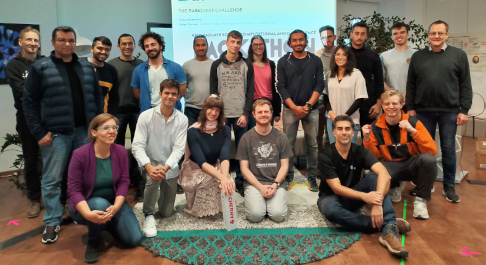
The hackathon on precipitation estimation with weather radar and rain gauge data took place from October 8-11, 2024 at Triangel Studio.
Read moreAbout KCDS
Coordination KIT Graduate School Computational and Data Science
 +49 721 608-47748
 angela huehnerfuss ∂does-not-exist.kit edu
 www.kcds.kit.edu/